Irrigation & Heat Stress Automation
Industry Partners: Nelson Irrigation Corp., Wiseconn Engineering, SWAN Systems, Dynamax Inc.
WSU Team: Srikanth Gorthi, Dattatray Bhalekar, Prasanna Medarametla, Juan Munguia, Lav Khot, Bernardita Sallato, R. Troy Peters
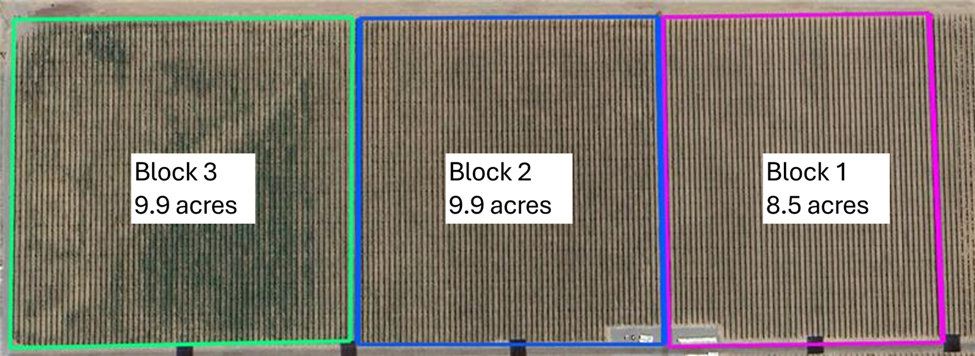
Orchard irrigation automation is essential to realize block uniformity and optimal yield following sustainable production practices. At WSU Smart Apple Orchard testbed, we have multiple commercial partners collaborating with Washington State University team to evaluate their soil-plant-atmosphere continuum sensing, climatic modeling driven decision support, and automated line control at block level. Since 2024 season, the evaluation is being conducted for following three scenarios.

Scenario 01
In block 1, irrigation system has been completely automated using a centralized controller (RF-X1, Drop Control, Wiseconn Engineering). Soil moisture probe (Drill & Drop 36’’, Sentek Inc.) data from up to 3 ft (90 cm) is being logged using a field station node (RF-X1, Drop Control, Wiseconn Engineering) at 15-min interval. SWAN Systems (Water, Nutrient, & Precision irrigation Software, SWAN Systems Inc.) uses this data along with AgWeatherNet station data, crop coefficient (varied across the season), and site-specific weather forecasts (Source: MeteoBlue, Basel, Switzerland) to run the climatic model to realize a weekly irrigation schedule. SWAN Systems has a web interface to run the irrigation scheduling and push it to the controller (e.g., Drop Control, Wiseconn Engineering). This model-based irrigation scheduling was implemented during the growing season until harvest. Similarly for heat stress management in block 1, commercial partners have integrated hardware to realize automated fogging during summer (July to September) months. Overhead fogging system has been installed underneath the netting (12% shade net). An IR temperature sensor (SapIP-IRT, Dynamax Inc.) continually monitors the canopy temperature in upper top sections at 15-min interval. At set threshold of canopy temperature (e.g., 38.6 °C [101 °F]) drop controller triggers actuation of solenoid valve to operate foggers (Jain by Rivulis, USA) with a differential temperature (3.4 °C [at 95 °F]) to turn off the cooling system.
Scenario 02
Similarly, in continuation from year 1, in block 2, the irrigation (and heat stress) has been managed by Columbia Farm Services using a solenoid valve controller (TWIG-V, Nelson Irrigation Corp.) tied to soil moisture probes data (Semios Inc., CA). These probes are installed at 8, 16, 24, 36-in. and send data to Semios web interface. In contrast to year 1, the new grower management decided to use under-tree sprinklers aggressively for row cover crop management, which added significant moisture in addition to drip irrigation scheduling. Moreover, soil and plant water stress indicators were collected using sap flow sensors (SGEX-25, Dynamax Inc.). Similarly, the cooling system (overhead foggers) was automated using the solenoid valve controller with continuous water application until 18:00 starting at fruit surface temperatures higher than 38.6 °C [101 °F].
Scenario 03
In block 3, WSU team has deployed sensors to monitor soil-plant-atmosphere continuum. To account for spatial variability, we deployed the set of sensors at four different locations inside the block having consistent root stock and soil properties. Each set of location have air temperature and humidity probes (ATMOS 14, Meter Group Inc.), thermistors (ST-200, Apogee Instruments), IR temperature sensor (SI-141, Apogee Instruments), stem water potential sensor (SWP, Florapulse Inc.), soil moisture and matric potential sensors (TEROS 11; TEROS 21, Meter Group Inc.) at 8 and 24 in. monitoring the microclimate and soil/plant water stress for precision and automated irrigation and heat stress management. The data was collected at 5-min intervals for all the sensors except for thermistors, which was configured at 1-min for noise filtering and decision making. All these sensors are integrated with LoRaWAN sensing nodes, where the decision support for irrigation and heat stress management was performed on AWN Smart Farm platform (beta version). For precision irrigation, the platform performs sensor fusion between soil moisture and stem water potential (SWP) with thresholds of 12 bars for SWP and 75% of plant available water. For precision heat stress management, data from multiple sensing nodes is aggregated and the cooling system is triggered at set threshold of fruit temperature (e.g., 38.6 °C [101 °F]) and operate foggers (Jain by Rivulis, USA) with a differential temperature (3.4 °C [at 95 °F]) to turn off the cooling system.
Ground Truthing
In all blocks, WSU Precision Ag group has installed water flow meters (SW-3L, Dragino Inc.) to monitor and quantify water used for heat stress mitigation. This block also has micro-tensiometer probes (MT FloraPulse, Davis) inserted into the trunks for real-time plant water status monitoring along with soil moisture probes (TEROS 12, Meter Group Inc.) at 8 and 24 in. for soil moisture tracking. An all-in-one weather station (ATMOS 41, Meter Group Inc.) has been deployed inside and outside the orchard to quantify the orchard effects on weather variables. For evapotranspiration (ET) estimation and its comparison with weather data derived estimates, an eddy covariance based actual ET sensor (LI-710, LI-COR Environmental) has been deployed at 2-m (6 ft) above the canopy. All the data gets collected through LoRaWAN (Long range wide area network) based wireless sensing network (WSN) developed by our team. Similarly in block 2, micro-tensiometer and soil moisture probes have been installed to monitor plant and soil water status. In addition, Sallato lab has been doing ground truthing of canopy water stress, nutrient status, fruit size, and quality.
To evaluate the fogging systems, periodic (30 minutes) manual measurements were taken using a contact temperature probe (Thermapen Blue, ThermoWorks Inc.) and non-contact thermal-infrared imager (One Edge pro, FLIR Systems, Inc.). Contact temperature probe quantifies fruit surface temperature (FST), and non-contact thermal-infrared imager quantifies FST and canopy temperature. These measurements were taken in all the treatments on selective heat events (five days) throughout 2025 summer season. Moreover, to assess the effect of cooling treatments on yield (fruit count and weight per tree) and fruit quality parameters, five randomly selected trees per treatment were harvested at starch content index 2. The fruit quality was quantified by visually assessing the incidence of various disorders, including necrosis, photooxidative sunburn, browning, early sunburn, and green spot.
Significant Findings
- In scenario 1, where irrigation scheduling was based on a commercially available model that uses soil moisture, localized weather and forecasts data as inputs, 20.8% (year 2) to 52.4% (year 1) water saving was realized compared to grower control block.
- Similarly, 46.4% (scenario 1, year 1) and 50.7% (scenario 3, year 2) of water saving was observed for precision and automated heat stress management using real-time fruit/canopy temperature driven cooling system actuation.
- Grower control block (scenario 2, year 1) had larger fruit; weight and diameter equivalent to one box size different (56 to 64 mm). Starch levels were lower; however, this difference has no agronomic significance.
- The estimated effective yield in automated block (scenario 1, year 1) was 21% higher, with 232% higher water use efficiency compared to Grower control block. Per the estimates, Automated and Grower control block respectively had about 116 and 50 lbs of fruit per thousand gallons of water applied.
- Year 2 yield and fruit quality data analysis is in progress.
As part of WSU research trials, we are evaluating various fogging systems to mitigate heat stress in apples. For more information, please click this link.