Mobile Applications for Actionble Orchard Management Insights
AWN CropAI
WSU Team: Nipun Thennakoon, Dheeraj Vurukuti, Basavaraj Amogi, Bernardita Sallato, Lav Khot
AWN CropAI is a specialized smartphone platform from WSU AgWeatherNet that utilizes AI-driven insights to help growers manage environmental stressors. By integrating radiometric thermal imaging with artificial intelligence, the platform delivers real-time assessments of fruit surface and canopy temperatures to optimize heat mitigation and quality management. These features, along with seven-day, hourly fruit surface temperature (FST) forecasts, enable the immediate identification of sunburn risk and canopy stress for more proactive resource allocation. Such foresight is vital in Eastern Washington, where diminishing winter snowpacks and subsequent summer water shortages necessitate precise heat stress management under increasingly constrained resources.
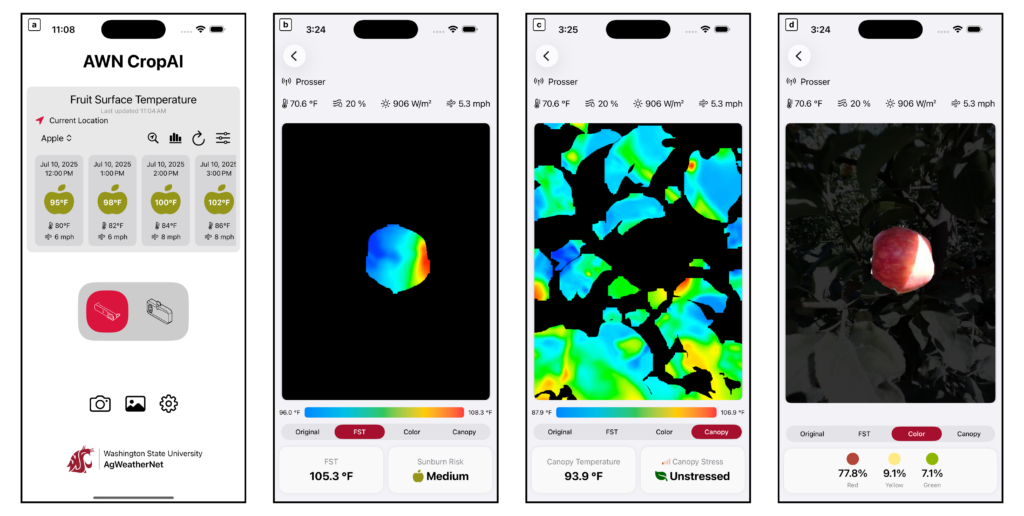
Beyond monitoring FST and canopy health, AWN CropAI also quantifies fruit color development (e.g., % red, % green, % yellow) instantly. By utilizing the CIELAB (L*a*b*) color space, the application maintains accurate readings despite fluctuating field lighting conditions. AWN CropAI is available for free on both Android and iOS platforms. Growers, researchers, and industry professionals can download it via the links or QR codes provided below.
- iOS: Apple App Store
- Android: Google Play Store
Publications
AWN CropAI-SWD
WSU Team: Srikanth Gorthi, Dheeraj Vurukuti, Dattatray Bhalekar, Lav Khot, Gwen Hoheisel, Betsy Beers
AWN CropAI-SWD is a smartphone application focused on streamlining the identification and quantification of Spotted Wing Drosophila (SWD) larvae in berry and stone fruits. These pests pose a serious threat to crop yield, as adult flies lay eggs directly in the fruit, allowing larvae to develop internally and compromise harvest quality.
Traditional monitoring techniques involve SWD vinegar traps to attract adult flies, but trap presence does not directly indicate infestation levels within the fruit. To obtain accurate assessments, a manual methodology was developed to extract larvae from berries using a salt solution, followed by filtering through coffee filters and microscope analysis. While effective, this process is time-intensive and prone to subjectivity.
AWN CropAI-SWD leverages AI models trained on lab and field image datasets to automate this task. The app currently detects:
- 2nd instar larvae (3.5–5 mm)
- 3rd instar larvae (>5 mm)
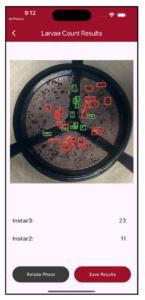
Download AWN CropAI-SWD for free on iOS via this link or the QR code below.
Publications
- Coming soon.
Aerobotics
Industry Partner: Aerobotics, South Africa
WSU Team: Juan Munguia, Bernardita Sallato, Lav Khot
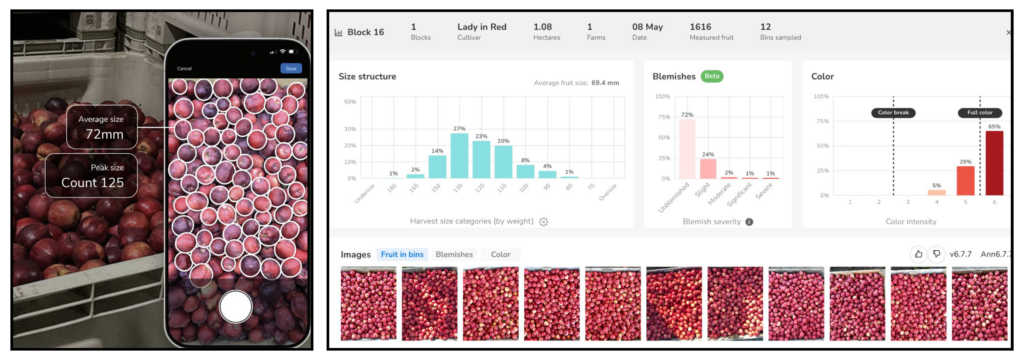
Aerobotics is a smartphone-based platform designed to support fruit yield estimation and crop monitoring through digital fruit counts and image-based fruit sizing. The platform uses artificial intelligence (AI) and computer vision algorithms to estimate fruit size from captured imagery. Its TrueFruit™ Size tool generates block-level reports at the time of data collection and provides forecasts of expected fruit size at harvest. The TrueFruit™ Bin feature estimates fruit size distribution at the bin level prior to packing operations, while the recently introduced TrueFruit™ Grade tool evaluates external fruit attributes such as color development and visible blemishes.
The platform currently operates on iPhone 15 Pro models or newer, utilizing the device’s integrated LiDAR sensor to support image acquisition and spatial analysis. Data collection involves capturing images from multiple trees within a block or individual bins, depending on the intended assessment. Following image acquisition, the software processes the data and generates analytical reports that can be reviewed within the Aerobotics platform at the individual sample, block, or cultivar scale. The system also enables tracking of sampling activities, including measured blocks, number of images collected per location, personnel responsible for data acquisition, and collection status.